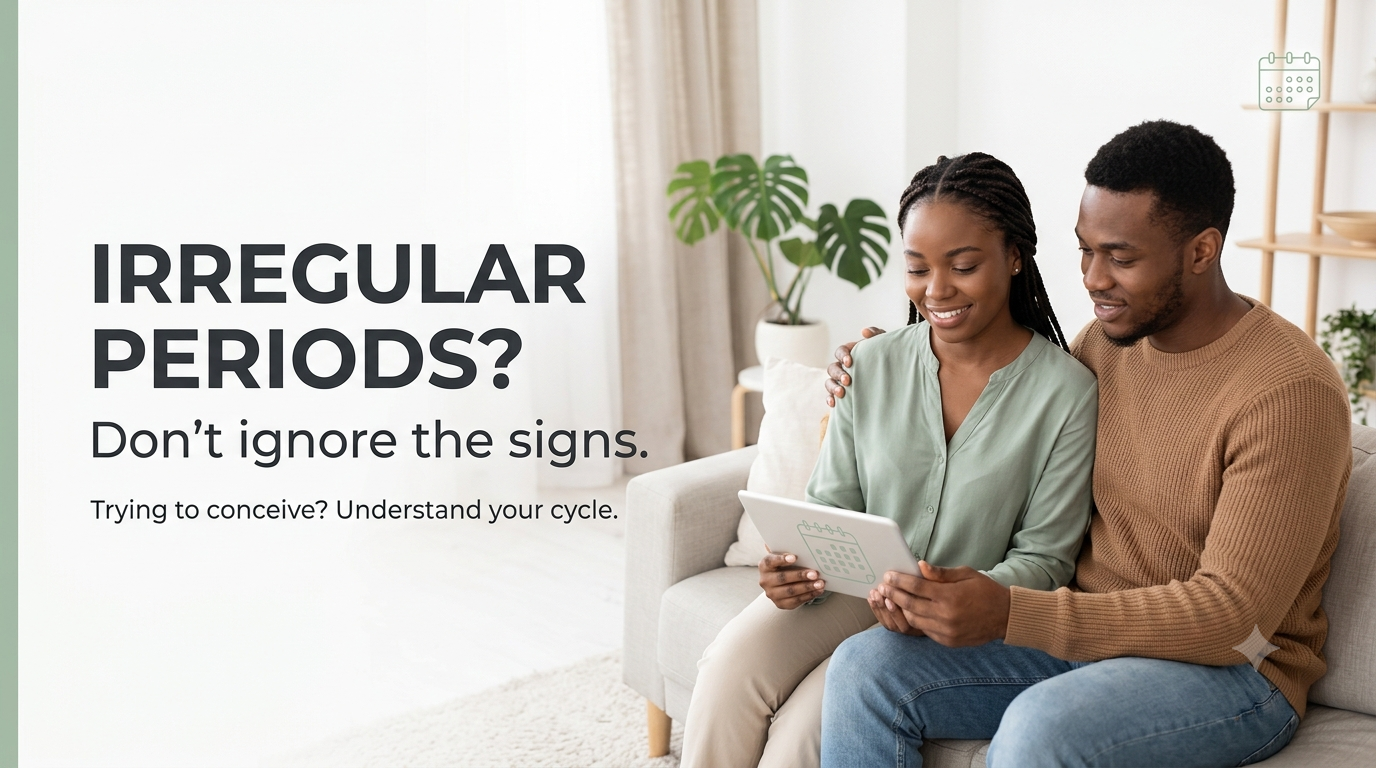
Irregular Periods and Fertility: Stop Ignoring What Your Cycle Is Telling You.
Missing periods for months, unpredictable cycles or bleeding that suddenly changes should not simply become your new “normal” — especially when you’re trying to conceive.
Your menstrual cycle is more than a date on a calendar. It can provide useful information about what may be happening with ovulation and your reproductive health.
An occasional late period can happen.
Stress, illness, travel, weight changes and other temporary factors can sometimes affect a menstrual cycle.
But when periods repeatedly disappear, arrive unpredictably or become very different from your usual pattern, it deserves attention.
If your period disappears for two, three or even several months, why keep waiting for your body to “fix itself” without understanding what may be disrupting your cycle?
Why do irregular periods matter when you’re trying to conceive?
Pregnancy requires an egg to be released from the ovary. This process is called ovulation.
Regular menstrual cycles do not guarantee perfect fertility, but very irregular or absent periods may sometimes be a sign that ovulation is happening inconsistently or not happening during certain cycles.
If ovulation becomes difficult to predict, identifying the fertile window can also become more difficult.
7 possible reasons your periods may become irregular
Irregular menstruation is not one diagnosis. Several different factors can affect the menstrual cycle.
Polycystic ovary syndrome (PCOS)
PCOS is a common hormonal condition that can be associated with irregular or absent periods, changes in ovulation, acne, excess hair growth and other symptoms.
Thyroid problems
Thyroid hormones influence many body functions. Both an underactive and overactive thyroid can sometimes affect menstrual patterns.
Significant weight changes
Rapid weight loss, very low body weight, obesity or major changes in eating patterns may influence reproductive hormones and menstrual regularity.
Stress and excessive physical strain
Severe psychological stress or very intense physical activity can sometimes disrupt the hormonal signals involved in menstruation.
Elevated prolactin or other hormonal changes
Abnormal levels of certain hormones may interfere with normal ovulation and menstrual cycling.
Changes related to age and ovarian function
Menstrual patterns can change as reproductive hormone levels change with age. Persistent changes should be interpreted alongside age, symptoms and fertility goals.
Medications and other medical conditions
Certain medicines and health conditions can affect menstruation. This is one reason a complete health history matters.
When should irregular periods receive more attention?
One unusual month does not necessarily mean something serious is wrong. But patterns matter.
Repeatedly missing periods without pregnancy deserves proper evaluation.
Large changes from one cycle to another can make ovulation harder to predict and may warrant assessment.
Cycle irregularity becomes especially relevant when pregnancy is not happening as expected.
Acne, unusual hair growth, major weight changes or other symptoms may provide additional clues.
Very heavy or prolonged bleeding should not simply be ignored.
Persistent or severe pelvic pain deserves appropriate medical assessment.
Can supplements help with women’s reproductive wellness?
This is where many women make an understandable mistake.
They see an irregular cycle and immediately begin buying products advertised for hormones, fertility or ovarian health.
But the first question should not be: “Which supplement should I buy?”
The first question should be: “Why is my cycle irregular?”
Adequate nutrition supports normal hormone production, general health and normal reproductive function.
Individual dietary patterns and deficiencies may sometimes justify targeted nutritional support.
A woman with PCOS may require a very different approach from someone whose periods changed because of thyroid problems, major weight loss or another condition.
Nutritional products make more sense when used alongside appropriate assessment, healthy habits and professional guidance.
They do not replace pregnancy testing, hormonal evaluation, ultrasound, fertility assessment or appropriate medical treatment when those are needed.
What should a woman actually do next?
Record when bleeding starts, how long it lasts and major changes in your usual menstrual pattern.
A missed period can have many causes, but pregnancy should be considered when pregnancy is possible.
If your cycle repeatedly disappears for long periods, understanding why matters.
Depending on your circumstances, assessment may involve medical history, laboratory testing, imaging or other evaluation.
When pregnancy is taking longer than expected, fertility assessment should not automatically focus on the woman alone. Both partners can contribute to fertility challenges, so evaluating both sides can provide a clearer picture and prevent unnecessary delays.
Choose supplements according to your actual needs, health history and nutritional status rather than depending on products that promise guaranteed pregnancy or instant hormone correction.
Nutritional support can be useful as part of a broader fertility plan, but it should complement proper evaluation, healthy nutrition and appropriate professional guidance.
Your menstrual cycle should not become a mystery you simply tolerate. If something keeps changing, understand why.
Don’t wait until years of uncertainty have passed.
An irregular period does not automatically mean infertility.
PCOS does not automatically mean pregnancy is impossible.
Missing one period does not automatically mean something serious is wrong.
But when your periods repeatedly disappear, become unpredictable or change significantly from your normal pattern, your body may be giving you information that deserves attention.
This becomes even more important when you are actively trying to conceive.
Instead of spending month after month wondering whether the next cycle will be different, begin by understanding what may be affecting ovulation, hormones and your reproductive health.
The goal is not to create fear.
The goal is to replace uncertainty with information.
Irregular periods and trying to conceive?
Don’t keep waiting month after month without understanding what may be affecting your cycle. Tell the VicMos Wellness team what you have been experiencing and get guidance on an appropriate next step.
Your conversation is handled privately. VicMos Wellness provides wellness guidance and does not replace professional diagnosis, fertility testing or emergency medical care.
Continue your wellness journey
Useful wellness guidance, new arrivals and selected offers.
Related articles

Your situation may need a more personal conversation.
Tell the VicMos Wellness team what you are looking for and continue privately on WhatsApp.